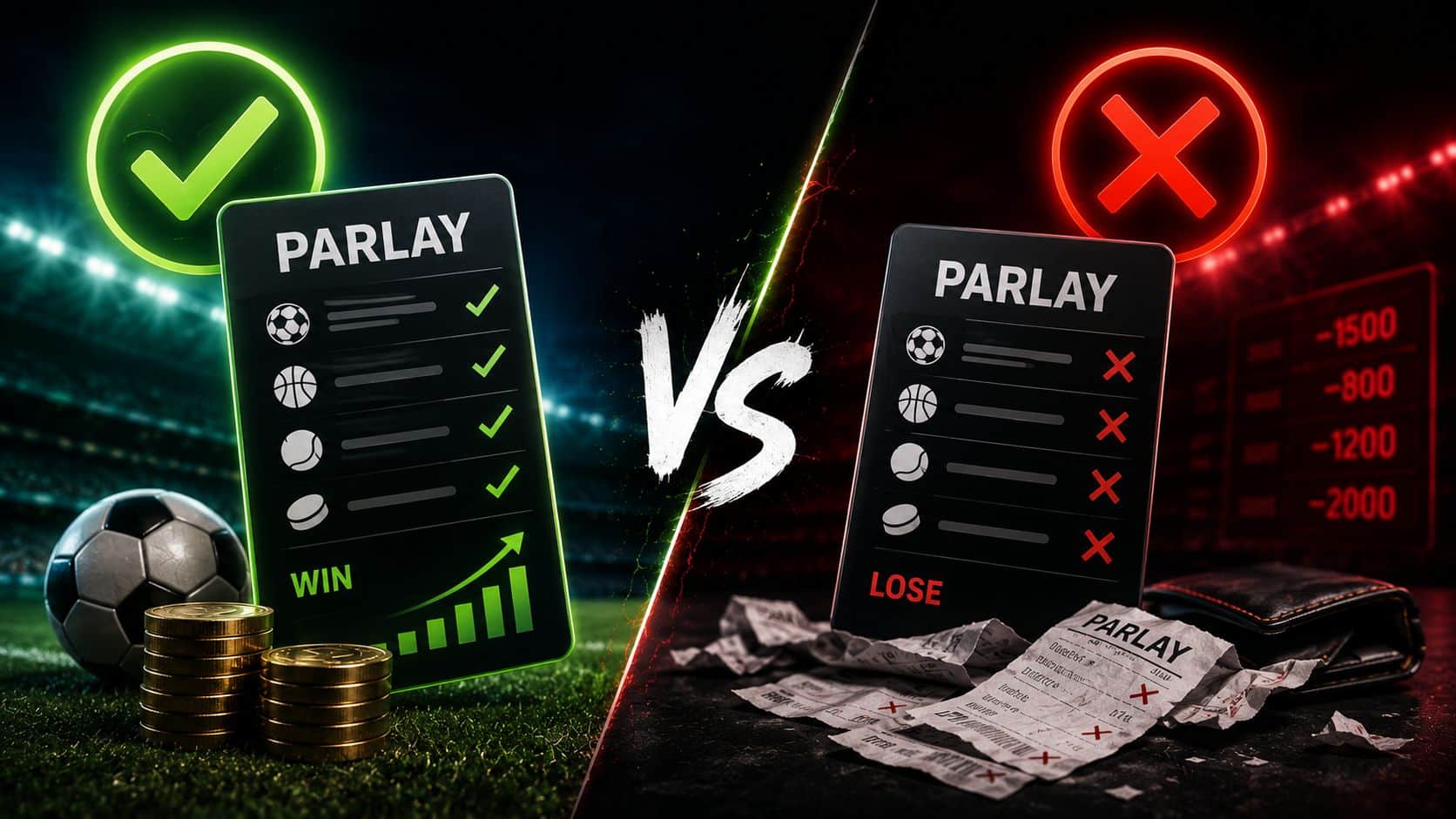
A parlay combines several bets into one, where every selection must win – the payouts look huge, but the maths is brutal, because the bookmaker’s margin compounds with each added leg. Parlays are the most exciting and most misused bet in the game. This guide explains the real maths, when a parlay can be defensible, the mistakes that turn them into lottery tickets, and a smarter approach.
Say you add four selections, each with a roughly 50% chance. Individually that is a coin flip; combined, all four landing is about 0.5 × 0.5 × 0.5 × 0.5 = 6%. The payout is large because the probability is tiny. Worse, the bookmaker’s built-in margin sits on every leg, so stacking legs multiplies their edge as well as your potential payout. That is why parlays are advertised so aggressively: they are highly profitable for the sportsbook.
Parlays sell a feeling: a small stake, a giant potential return, the dream of one ticket changing your week. That dopamine is exactly what makes them dangerous. Most parlay bettors lose steadily, funding the rare big winner everyone screenshots. The screenshots survive; the hundreds of losing slips do not.
| Reckless parlay | Defensible parlay |
|---|---|
| Legs picked for big odds | Every leg is an independent value bet |
| 8+ legs for a huge payout | Few legs, kept tight |
| Gut-feeling selections | Model-backed selections |
| Whole bankroll on one slip | Small, fixed stake |
| Chasing the dream win | Treated as a minor add-on |
In short: a parlay is only defensible when each leg would be a sound value bet on its own. Combine genuine edges and the parlay inherits them; combine hopeful guesses and you just multiply the bookmaker’s margin.
Disciplined bettors lean on value singles for steady returns and treat parlays as occasional, small-stake fun – never the core strategy. The principle is the same as everywhere in sharp betting: only bet when the odds beat the true probability. 69 Advisory’s model is built to find exactly those value spots, so your selections – single or combined – start from a real edge rather than a hopeful guess.
Build from genuine value, not lottery tickets. See how 69 Advisory’s model finds the edges worth backing.
Check the documented record first on the statistics page.
Parlays are usually poor value because the bookmaker’s margin compounds with each leg and every selection must win. They can be defensible only when each leg is a genuine value bet, kept to few legs and a small stake.
Probabilities multiply, so the chance of every leg winning drops quickly, while the bookmaker’s edge stacks with each added leg. The big payout exists precisely because the outcome is unlikely.
Fewer is generally better. The more legs you add, the lower the probability and the worse the value. A defensible parlay keeps legs tight and uses only selections that are value bets on their own.
For steady, long-term returns, value singles usually beat long parlays because they avoid compounding the bookmaker’s margin. Parlays are best treated as occasional small-stake fun.
69 Advisory’s data-driven model identifies value spots, so any selection – single or part of a parlay – starts from a real edge rather than a guess, with a transparent record to verify.
Sports betting carries financial risk. 69 Advisory provides data-driven analysis, not guaranteed outcomes. Only stake what you can afford to lose, and if gambling stops being fun, seek support. 21+ where required by law. Gamble responsibly.
October Baseball: Why the Postseason Is a Different Betting Market
Smaller rosters, no automatic runner, aces on short rest and relievers throwing over half the innings. The playoffs are not the regular season with higher stakes.
Read articleChasing Losses: The Psychology of Tilt and How to Interrupt It
Chasing costs more money than bad selections ever will. Here is what is actually happening cognitively, and the interventions that work.
Read articleSetting Betting Limits That Actually Hold: A Practical Guide
Good intentions fail under pressure. Deposit limits, time-outs and self-exclusion work because they do not rely on willpower at the moment it is weakest.
Read article

 Back to blog