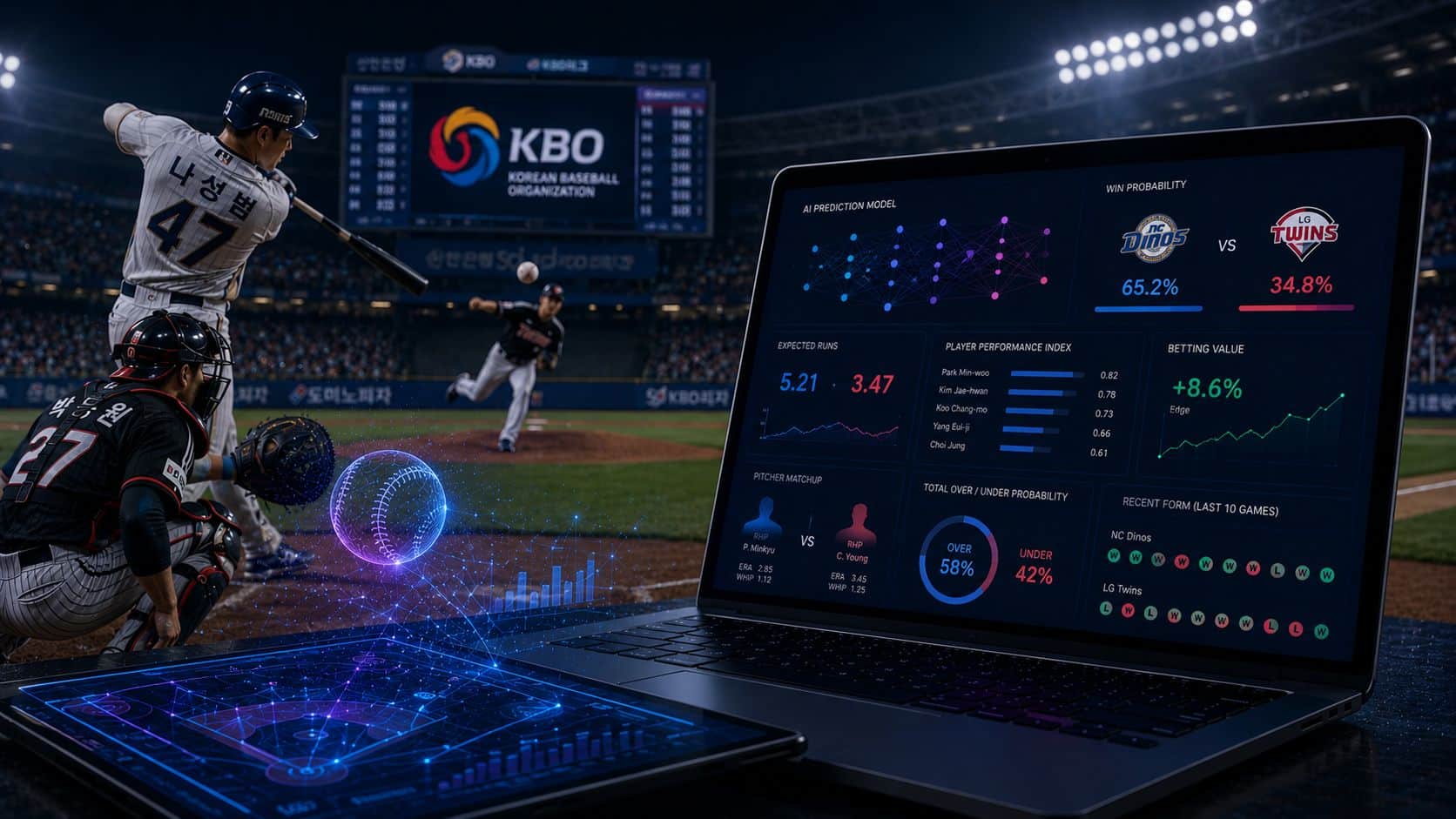
The Korean Baseball Organization is one of the most underexploited markets in global sports betting. While MLB markets attract massive sharp money that quickly prices out inefficiencies, KBO operates in a different equilibrium – lower betting volume, less analyst attention, and significant information asymmetries between Korean and Western audiences create persistent opportunities that algorithmic prediction systems can exploit consistently.
This isn’t theoretical. The KBO had its moment in 2020 when, during the COVID pandemic, it became one of the few major sports operating globally. Western audiences discovered the league, betting markets expanded, and the underlying market inefficiency became visible to anyone paying attention. Most Western bettors then moved back to MLB when American baseball returned. The opportunity, however, didn’t disappear – it just stopped being trendy.
This guide explains why KBO remains an attractive market for systematic bettors, how AI prediction models approach Korean baseball specifically, and what makes algorithmic edge here different from MLB.
The Korean Baseball Organization shares fundamental rules with MLB but differs in important ways that matter for prediction.
League structure. Ten teams play 144 games each in the regular season, followed by a playoff structure that culminates in the Korean Series. Compared to MLB’s 30 teams and 162 games, KBO is more concentrated – each team plays each other team more frequently, creating familiarity effects between rosters that affect outcomes.
Game style and scoring environment. KBO has historically been a higher-scoring league than MLB, though this has fluctuated with the official ball changes (the league modified ball construction in 2019 to reduce scoring). Run scoring patterns differ enough from MLB that models trained on American baseball don’t transfer directly.
Ballpark factors. Korean stadiums have unique dimensions and characteristics. Some heavily favor pitchers, others are notorious hitters’ parks. Local weather patterns and stadium-specific microclimates affect scoring in ways that need to be modeled separately from MLB.
Roster construction rules. KBO teams can have up to three foreign players, typically including at least one pitcher. The performance and stability of these foreign players significantly affects team quality and predictability. Foreign player turnover creates roster volatility that doesn’t exist at the same scale in MLB.
Game scheduling. KBO plays a heavy weekend schedule with Mondays off. This creates different rest patterns than MLB’s daily grind and affects bullpen usage patterns.
Cultural and tactical differences. Korean baseball culture emphasizes small ball more than modern MLB – more sacrifice bunts, more stolen base attempts, more situational hitting. This affects expected scoring patterns and creates different statistical signatures than MLB.
These differences matter because they mean MLB-trained models don’t translate to KBO. Services genuinely covering Korean baseball need dedicated KBO models, not extensions of American baseball systems.
The same factors that make KBO different from MLB create persistent market inefficiencies.
Information asymmetry between Korean and Western sources. Korean baseball media covers the league in depth, but most of this content isn’t in English. Western bettors and bookmakers rely on translated summaries that often lag actual developments. Models that incorporate Korean-language sources have informational advantages.
Lower sharp money concentration. MLB markets attract enormous amounts of sharp money that aggressively prices inefficiencies. KBO sees less sharp action proportionally, meaning lines move less aggressively in response to algorithmic bettors.
Bookmaker model limitations. Many sportsbooks use simpler models for KBO than for MLB because the betting volume doesn’t justify the same investment. This creates pricing errors that wouldn’t survive in major leagues.
Foreign player effects underweighted. When a team’s top foreign starter has a great or terrible recent stretch, markets often underprice the effect on team performance. Models that properly weight foreign player impact find edge consistently.
Schedule and travel underweighted. KBO’s heavy weekend schedule and concentrated travel patterns create rest and fatigue effects that recreational betting doesn’t account for.
Public bias toward big-market teams. Just as MLB markets overprice the Yankees and Dodgers based on public perception, KBO markets often overprice the Doosan Bears, LG Twins, and other Seoul-based teams that get more attention. Systematic fading of public bias works in KBO as elsewhere.
The aggregate result is a market where genuine analytical work translates to persistent edge that wouldn’t survive in more efficient markets.
Sophisticated KBO prediction models use similar data categories to MLB models but require KBO-specific calibration.
Starting pitcher analytics. Korean pitchers and foreign pitchers in KBO have different performance profiles than MLB starters. Strikeout rates are typically lower, contact quality matters more. Models track:
Bullpen quality. KBO bullpens often differ in usage patterns from MLB. Closer roles can be less clearly defined; managers use late-inning relievers more flexibly. Models adjust for actual usage patterns rather than nominal roles.
Offensive metrics. Korean baseball stats are increasingly available in advanced forms. Models incorporate:
Foreign player tracking. The performance, health status, and adaptation curve of foreign players is critically important and constantly changing. Models that don’t separately track foreign player performance miss major prediction inputs.
Weather and environmental factors. Korean weather creates predictable scoring environment shifts – hotter summer months produce more offense, monsoon season affects pitching command, autumn games have different conditions than mid-summer.
Recent form and underlying performance. As in MLB, models distinguish actual quality from recent results variance. Teams that have been outperforming their underlying metrics will regress; teams underperforming will improve.
Most Western prediction services don’t cover KBO meaningfully. The market is smaller than MLB, the data infrastructure requires dedicated work, and the cultural distance creates research costs that many services don’t want to absorb.
69advisory built KBO coverage during the 2020 COVID-era when Korean baseball was among the only major sports running globally. Rather than retreating to MLB-only when American baseball returned, the KBO coverage continued because the underlying market inefficiency continued. That early specialization translated into sustained edge that’s now part of the daily recommendation system across the league’s season.
This is the kind of niche specialization that’s hard to replicate quickly. Building genuine KBO prediction capability requires multi-year investment in data infrastructure, Korean-language sources, and ongoing model refinement. Services that haven’t done this work but claim KBO coverage are typically applying MLB models to Korean games – an approach that doesn’t capture the league’s unique characteristics.
Not all KBO betting markets are equally exploitable.
Moneyline. The basic win/loss market is reasonably efficient on big games but mispriced on less-attention games. Edge concentrates in mid-week matchups between non-Seoul teams.
Run line (-1.5/+1.5). Higher-variance market with more pricing inefficiency. The 1.5 run handicap creates more opportunities for model edge than straight moneyline betting.
Totals (over/under). One of the strongest edges for KBO models. The market often slow to adjust to scoring environment changes (weather, ballpark factors, recent offensive trends). Models that properly model expected runs find consistent value.
First five innings markets. These eliminate bullpen variance and focus on starting pitcher matchups. Models with strong starting pitcher inputs find edge here, though variance is higher than full-game bets.
Team totals. Individual team scoring markets are less efficiently priced than game totals. Edge is available but bet limits are often lower.
Markets to avoid or approach cautiously:
Korean Series and playoff games. Higher betting volume attracts sharper money. Edge shrinks during the postseason.
Heavy favorites at extreme prices. Even with model edge, betting -250 or worse rarely pays off after vig considerations.
Live betting. Limited live-betting infrastructure on KBO means inferior prices and lower limits than would justify systematic exposure.
Setting expectations matters.
KBO markets are more inefficient than MLB, but they’re not free money. Realistic professional yields:
These yields require:
69advisory’s documented 18,19% yield is measured across a multi-sport portfolio combining MLB, NHL, Premier League, KBO, NPB, and major tournaments over thousands of bets and multiple years. The KBO component contributes to this aggregate but isn’t isolated from the broader portfolio. Multi-sport diversification stabilizes returns in ways that pure single-league exposure cannot.
Bettors approaching KBO without proper preparation make predictable errors.
Applying MLB intuition. Korean baseball’s small ball culture, ball construction differences, and roster rules create patterns that don’t match MLB. Bettors who apply MLB heuristics to KBO consistently lose.
Underweighting foreign player news. When a team’s top foreign starter is injured, scratched, or struggling, the impact on team quality is large. Recreational bettors often don’t track this carefully.
Following Korean media buzz without context. Korean media coverage can amplify both positive and negative narratives. Bettors picking up English summaries of these narratives are often acting on stale or oversimplified information.
Ignoring scheduling effects. KBO’s heavy weekend schedule, doubleheader rules, and Monday rest patterns create rest effects that significantly impact team performance.
Betting on big-market teams reflexively. Seoul-based teams (Doosan, LG, Kiwoom) attract disproportionate attention. Their lines often reflect public perception more than actual quality.
Insufficient sample sizes for evaluation. A bettor’s first 50 KBO bets can profit or lose primarily through variance. Drawing conclusions about systems or models from small samples is the most common analytical error.
Subscribing to a quality service is only the start.
Execute every pick at recommended stakes. Selective execution converts systematic edge into emotional betting.
Get prices promptly. KBO lines move during the betting window, especially after lineup confirmations. Late execution erodes theoretical edge.
Track results carefully. Trust but verify. Service-published yields are aggregate; your actual results depend on execution quality.
Be patient through variance. Even strong models have losing weeks in KBO. The relatively short season means individual stretches matter more than in MLB.
Diversify across markets. Spreading across moneylines, totals, and props smooths variance.
Consider time zone effects on your routine. KBO games run during Asian afternoon/evening hours, which corresponds to Western middle-of-night times. Sustainable betting requires manageable scheduling.
KBO is one of those markets where the gap between sophisticated analytical approaches and casual betting remains wide. The combination of language barriers, cultural distance, and limited Western analyst attention creates conditions for sustained edge that wouldn’t survive in more efficient markets.
This won’t last forever. As global sports betting expands and analytical resources spread, KBO markets will become more efficient. But the timeline for that convergence is measured in years, not months. For bettors interested in sustainable algorithmic edge during this period, KBO offers something MLB increasingly doesn’t: room for analytical work to produce meaningful returns.
Korean baseball is one of the world’s most underexploited betting markets. The combination of high-quality data availability, persistent informational asymmetries between Korean and Western audiences, and lower sharp money concentration creates conditions where genuine analytical work produces sustained edge.
The market around “KBO predictions” contains some services applying MLB models without adaptation, some pure marketing without real methodology, and a small number of services with genuine Korean baseball expertise. Apply the evaluation criteria here. Demand methodology specific to KBO, not just generic claims about “AI predictions.” Verify track records over adequate samples. Check that the service has dedicated KBO coverage rather than treating it as an afterthought.
Korean baseball rewards specialized analytical attention more than most major betting markets. When you find a service combining real KBO methodology with honest transparency, the edge available is genuine – more sustainable than what MLB markets typically offer once you account for the smaller sharp money pressure.
18,19% yield. One AI-driven pick per day. KBO included. Start with 69advisory →
October Baseball: Why the Postseason Is a Different Betting Market
Smaller rosters, no automatic runner, aces on short rest and relievers throwing over half the innings. The playoffs are not the regular season with higher stakes.
Read articleChasing Losses: The Psychology of Tilt and How to Interrupt It
Chasing costs more money than bad selections ever will. Here is what is actually happening cognitively, and the interventions that work.
Read articleSetting Betting Limits That Actually Hold: A Practical Guide
Good intentions fail under pressure. Deposit limits, time-outs and self-exclusion work because they do not rely on willpower at the moment it is weakest.
Read article

 Back to blog