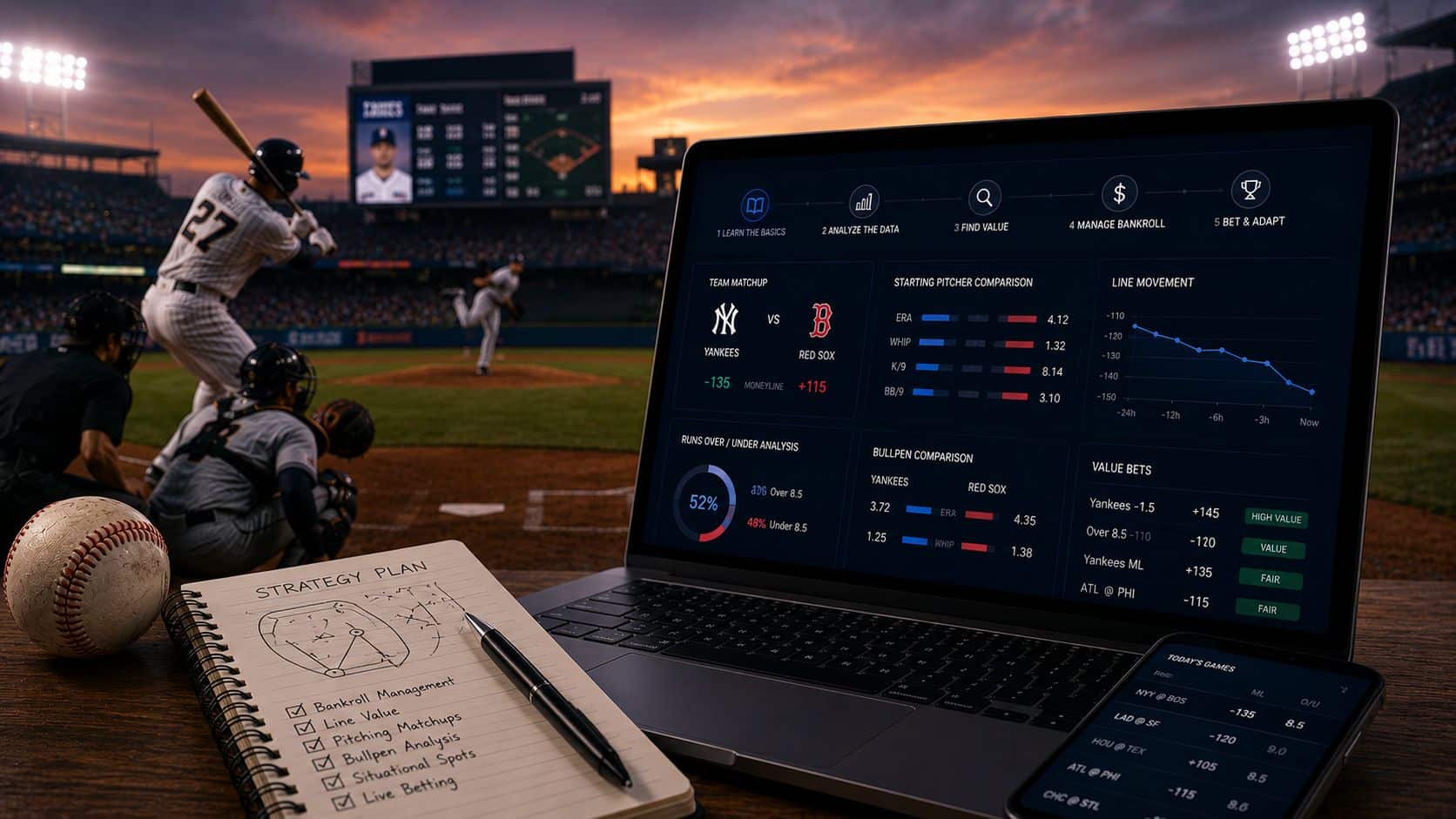
Baseball is the most analytically tractable major sport for betting. The volume of games, the granularity of available data, and the relatively independent nature of each at-bat create conditions where systematic approaches produce more consistent edge than in any other major sport. This is also why baseball is the sport where the gap between casual and professional betting is largest – and where serious approaches reward effort more than in football, basketball, or hockey.
This guide covers how to bet on baseball at every level, from understanding basic bet types to implementing the analytical approaches that produce long-term profit. Whether you’re new to MLB betting or trying to systematize an existing approach, the principles here apply.
Baseball betting offers more market types than most sports because of the game’s structure – 9 innings, many independent events, and well-defined statistical patterns. The major bet types are:
The simplest form: pick which team wins, regardless of margin. Lines are expressed in American odds format.
A favorite at -140 requires risking $140 to win $100. An underdog at +130 returns $130 on a $100 bet if they win.
Baseball moneylines are unusual in that even strong teams rarely carry prices much beyond -250, and underdogs frequently offer +150 to +200 prices that don’t exist as commonly in other sports. This is because baseball’s variance creates more uncertain outcomes than basketball or football, where favorites can dominate.
The implied probability for any moneyline tells you what win rate is necessary for break-even:
Strategic implications: Underdogs in baseball offer mathematically attractive opportunities when accurate probability estimates exceed implied probability. A team with 47% true win probability bet at +110 (47.6% implied) is approximately break-even; the same team bet at +130 is significantly profitable.
Baseball’s version of point spreads. The favorite gives up 1.5 runs; the underdog gets 1.5 runs.
A team listed at -1.5 runs must win by 2 or more runs. A team at +1.5 runs must win the game or lose by exactly 1 run.
Run lines typically have different juice than moneylines because the 1.5 run handicap shifts probabilities. Common pricing:
Strategic implications: Run lines create distinct value opportunities. Heavy favorites that win frequently but often by 1 run can be profitable plays on the run line. Strong underdogs that hang close in losses provide value on +1.5.
Predicting whether total combined runs will be over or under a posted number. Typical totals range from 7 to 11 runs depending on starting pitching, ballpark, and weather.
Both sides are usually priced near -110, with juice adjustments based on action.
Strategic implications: Totals are often considered the most analytically exploitable baseball market. Multiple variables drive total runs (starting pitchers, bullpens, ballpark, weather, lineup quality), creating room for sophisticated modeling to find pricing errors.
Markets covering only the first 5 innings of the game (sometimes called “F5”). These eliminate bullpen variance and focus on starting pitcher matchups.
Strategic implications: For bettors confident in starting pitcher analysis but less certain about bullpen quality, F5 markets isolate the more predictable element of games. Variance is higher (5 innings vs 9) but pricing inefficiencies can be larger.
Bets on individual player performance:
Strategic implications: Player props have grown rapidly with daily fantasy and proposition betting expansion. Markets are often less efficiently priced than game lines, but limits are typically lower.
Betting on games in progress with updating prices. Lines shift based on game state (current score, inning, pitch count, baserunners).
Strategic implications: Live betting can offer opportunities when in-game events shift probabilities faster than market prices adjust. Requires significant time investment to monitor games actively.
Five factors drive baseball game outcomes more than any others. Understanding these is the foundation of profitable betting.
The single most important factor. Starting pitchers throw the majority of game innings and largely determine run-scoring environment.
What matters:
What casual bettors miss: ERA is misleading short-term. A starter with 5.50 ERA but excellent peripheral metrics is likely to revert positively. A starter with 2.50 ERA but poor underlying performance is due for negative regression.
Strategic application: When line movement follows starting pitcher news (lineup changes, scratches, recall from minors), the changes often happen faster than recreational betting can absorb. Tracking starting rotations rigorously creates timing advantages.
Modern baseball features increasingly important bullpen usage. Games often hinge on relief pitching after the 6th inning.
What matters:
What casual bettors miss: Late-inning bullpen usage patterns differ dramatically by manager. Some managers reliably go to their closer; others mix and match. This affects late-inning win probability significantly.
Different stadiums produce dramatically different scoring environments.
Hitter-friendly parks: Coors Field (Colorado), Great American Ball Park (Cincinnati), Yankee Stadium (right field), Citizens Bank Park (Philadelphia).
Pitcher-friendly parks: Oracle Park (San Francisco), Petco Park (San Diego), T-Mobile Park (Seattle), loanDepot Park (Miami).
What matters:
Baseball is uniquely weather-sensitive among major sports.
Hot weather (85°F+): Ball flies further, more home runs, higher totals Cold weather (below 55°F): Ball doesn’t travel, fewer home runs, lower totals Wind blowing out: Increases home run probability significantly Wind blowing in: Suppresses home runs High humidity: Reduces ball flight slightly Rain potential: Affects pitcher grip and game pace
Strategic application: Markets often slow to adjust to weather changes during the day. Bettors monitoring weather closely can find totals opportunities when conditions shift from forecast.
Home plate umpire identity is announced before games and affects scoring environment.
What matters:
Why most bettors ignore this: Information isn’t always available, the effect per game is relatively small, and tracking umpire tendencies requires dedicated data.
Strategic application: Combined with other inputs, umpire effects shift expected totals enough to matter for marginal betting decisions.
Recreational bettors make predictable errors. Avoiding these alone improves results significantly.
Betting too many favorites. Public bias favors stronger teams. Sportsbooks price this in. Sustained moneyline favorite betting is mathematically guaranteed to lose to vig.
Betting based on recent results. Baseball variance creates hot and cold stretches that don’t predict future performance. Betting on teams “playing well” or fading teams “playing poorly” follows recent results rather than underlying quality.
Ignoring starting pitcher confirmation. Late lineup changes and pitcher scratches dramatically change probabilities. Betting before lineups are confirmed risks acting on incorrect information.
Parlay obsession. Multi-game parlays compound vig and destroy expected value. A 2-team parlay typically has 25-30% house edge versus 4.5% for straight bets.
Chasing losses with bigger stakes. The single fastest path to bankroll destruction. Every professional bettor maintains consistent stake sizing through downswings.
Betting too many games. Action junkie tendency. Profitable bettors are selective; betting every game guarantees you’re betting marginal opportunities.
Ignoring weather. Free information that meaningfully affects games. Casual bettors who don’t check weather are giving up edge.
Following public sentiment. Most popular plays are most heavily juiced. Going with the crowd typically means worse prices than going against.
For bettors interested in developing systematic approaches, the path requires sustained work.
Start with reliable data sources:
Build a system to track every bet with:
Without rigorous tracking, you can’t evaluate what’s actually working.
Decide on a probability estimation approach:
The methodology matters less than consistency. Whatever approach you use, apply it systematically and track results to refine over time.
Set staking rules and follow them:
Bankroll discipline determines whether analytical edge translates to actual returns or gets squandered through poor staking.
For bettors who don’t want to build analytical infrastructure from scratch, subscribing to professional services is a legitimate alternative.
What to look for:
What to avoid:
69advisory operates as one example of legitimate professional service – AI-driven candidate generation with human review, delivering one daily recommendation across MLB, NHL, Premier League, KBO, NPB, and major tournaments. The documented 18,19% yield over $95,000+ in tracked bets demonstrates what disciplined multi-sport algorithmic approaches achieve over time.
The choice between building your own analytical edge and using a professional service depends on time investment, expertise development, and personal preference. Both paths can work for disciplined bettors.
Set expectations based on math, not marketing.
Yield reality:
Variance reality:
Capital reality:
Baseball betting rewards analytical approaches more than perhaps any other major sport. The combination of data availability, sample size, and analytical tractability creates conditions where systematic work produces consistent edge over time.
The key requirements are discipline, patience, and realistic expectations. Profitable baseball betting isn’t get-rich-quick territory – it’s sustainable long-term work that produces modest but reliable returns when executed properly.
Whether you build your own analytical framework or use professional services, the principles remain consistent: identify market inefficiencies based on real factors (starting pitching, bullpen, parks, weather), execute disciplined stake sizing, track results rigorously, and maintain perspective through inevitable variance.
The math is unforgiving but also fair. Bettors who do the work see results compound over time. Those who treat it as entertainment or chase short-term variance lose systematically, just as the sportsbook business model predicts.
18,19% yield. One AI-driven pick per day. Start with 69advisory →
Chasing Losses: The Psychology of Tilt and How to Interrupt It
Chasing costs more money than bad selections ever will. Here is what is actually happening cognitively, and the interventions that work.
Read articleSetting Betting Limits That Actually Hold: A Practical Guide
Good intentions fail under pressure. Deposit limits, time-outs and self-exclusion work because they do not rely on willpower at the moment it is weakest.
Read articleThe Late-Inning Rules Most Bettors Miss: Three-Batter Minimum and Blowout Pitching
Two rule changes quietly reshaped how late innings are pitched. Both are public, both are precise, and both affect live totals more than most bettors realise.
Read article

 Back to blog