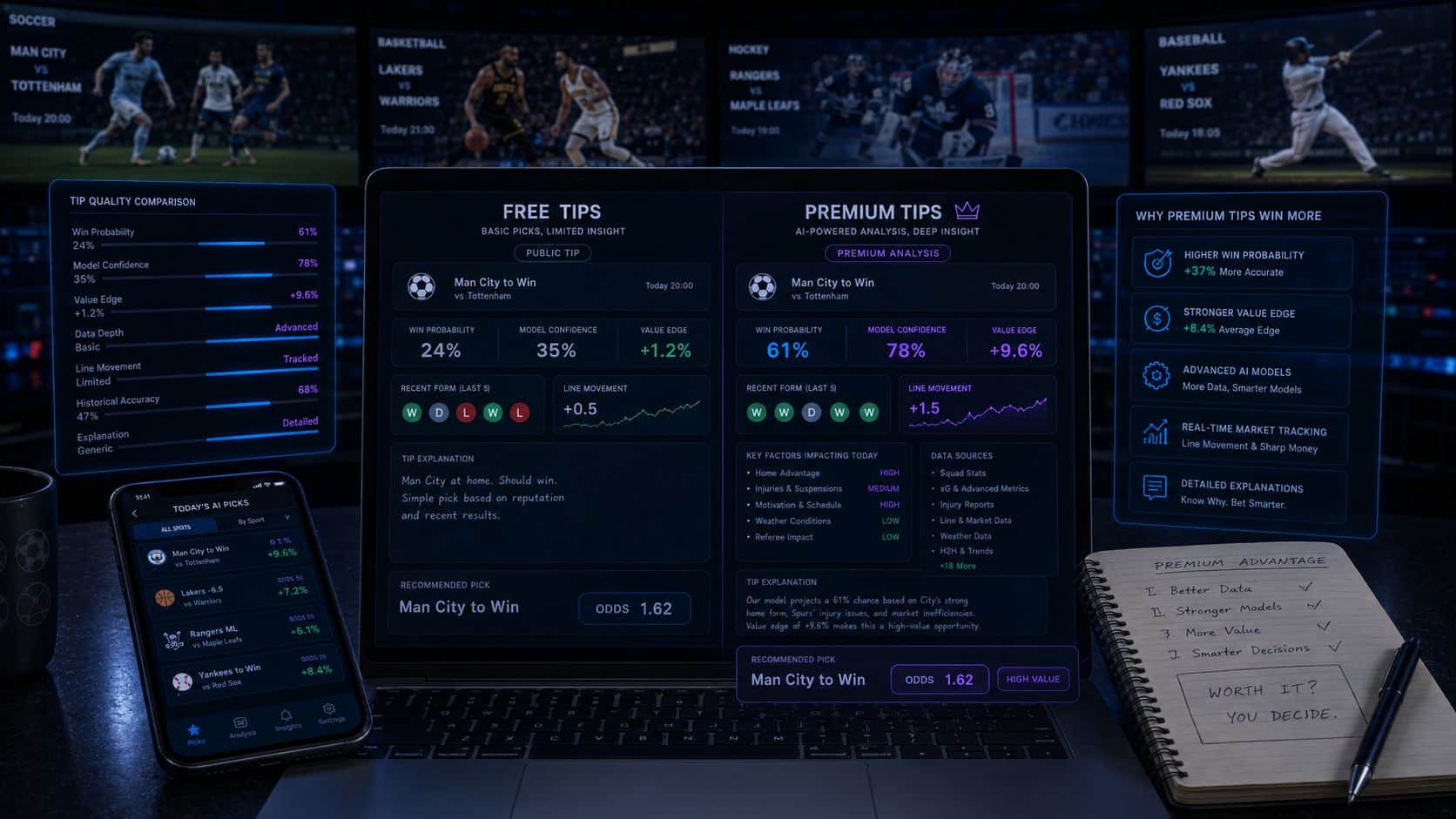
Paid betting tips are worth it only when the service is transparent, data-driven and has a verifiable record – otherwise you are simply paying for the same guesswork that free tips give away. The real question is not “free or paid” but “accountable or not”. This honest comparison breaks down both sides, the hidden costs, the red flags, and how to judge whether a fee is justified.
Free tips feel like a bargain, but they carry costs that never show up on an invoice. Free tipsters are paid in attention, so they optimise for excitement, not your bankroll. Common problems include:
| Free tips | Quality paid service |
|---|---|
| Opinion, often anonymous | Model-based probabilities |
| No track record | Transparent, dated, verifiable record |
| Optimised for clicks | Optimised for long-term value |
| Tips shared with everyone instantly | Controlled distribution to protect the price |
| No accountability | Reputation depends on documented results |
| Mixed, unclear staking | Clear unit-based staking guidance |
Honesty matters here, because plenty of paid services are worse than free. Avoid any paid tipster that refuses to show a full, dated record; guarantees profit; sells “fixed” matches; or displays only cherry-picked wins. A price tag is not proof of quality. The only thing that proves quality is a transparent record over a meaningful sample of bets.
Think of the fee as a cost that must be cleared before you are in profit. If a service genuinely produces value picks and you stake sensibly, the edge compounds over hundreds of bets and can outweigh the subscription – but only if the edge is real. That is precisely why the record matters so much: it is the only way to estimate whether the fee is an investment or just another expense. Never assume a fee buys an edge; verify it.
69 Advisory is built to pass exactly these tests: a data-driven AI model behind every pick and a transparent record you can inspect before deciding it is worth your money.
Judge for yourself: review 69 Advisory’s documented record, then decide if a data-driven paid service is worth it.
Start with the evidence on the statistics page before you spend a cent.
They are worth it only if the service is transparent, model-driven and has a verifiable track record. A paid tipster with no documented record is usually no better – and sometimes worse – than free tips.
Free tipsters are paid in attention, so they favour exciting accumulators and hide losing results. Without a verifiable record there is no accountability, and the maths often works against the bettor.
Look for a complete, dated record that includes losing periods, a clearly explained method, value-based framing rather than profit guarantees, and the ability to start small and verify.
Only if the underlying edge is real. With genuine value picks and sensible staking, the edge can outweigh the fee over a large sample – but you must verify the record first, because no fee guarantees an edge.
69 Advisory uses a data-driven AI model and publishes a transparent record, so subscribers can verify performance instead of trusting a claim.
Sports betting carries financial risk. 69 Advisory provides data-driven analysis, not guaranteed outcomes. Only stake what you can afford to lose, and if gambling stops being fun, seek support. 21+ where required by law. Gamble responsibly.
October Baseball: Why the Postseason Is a Different Betting Market
Smaller rosters, no automatic runner, aces on short rest and relievers throwing over half the innings. The playoffs are not the regular season with higher stakes.
Read articleChasing Losses: The Psychology of Tilt and How to Interrupt It
Chasing costs more money than bad selections ever will. Here is what is actually happening cognitively, and the interventions that work.
Read articleSetting Betting Limits That Actually Hold: A Practical Guide
Good intentions fail under pressure. Deposit limits, time-outs and self-exclusion work because they do not rely on willpower at the moment it is weakest.
Read article

 Back to blog