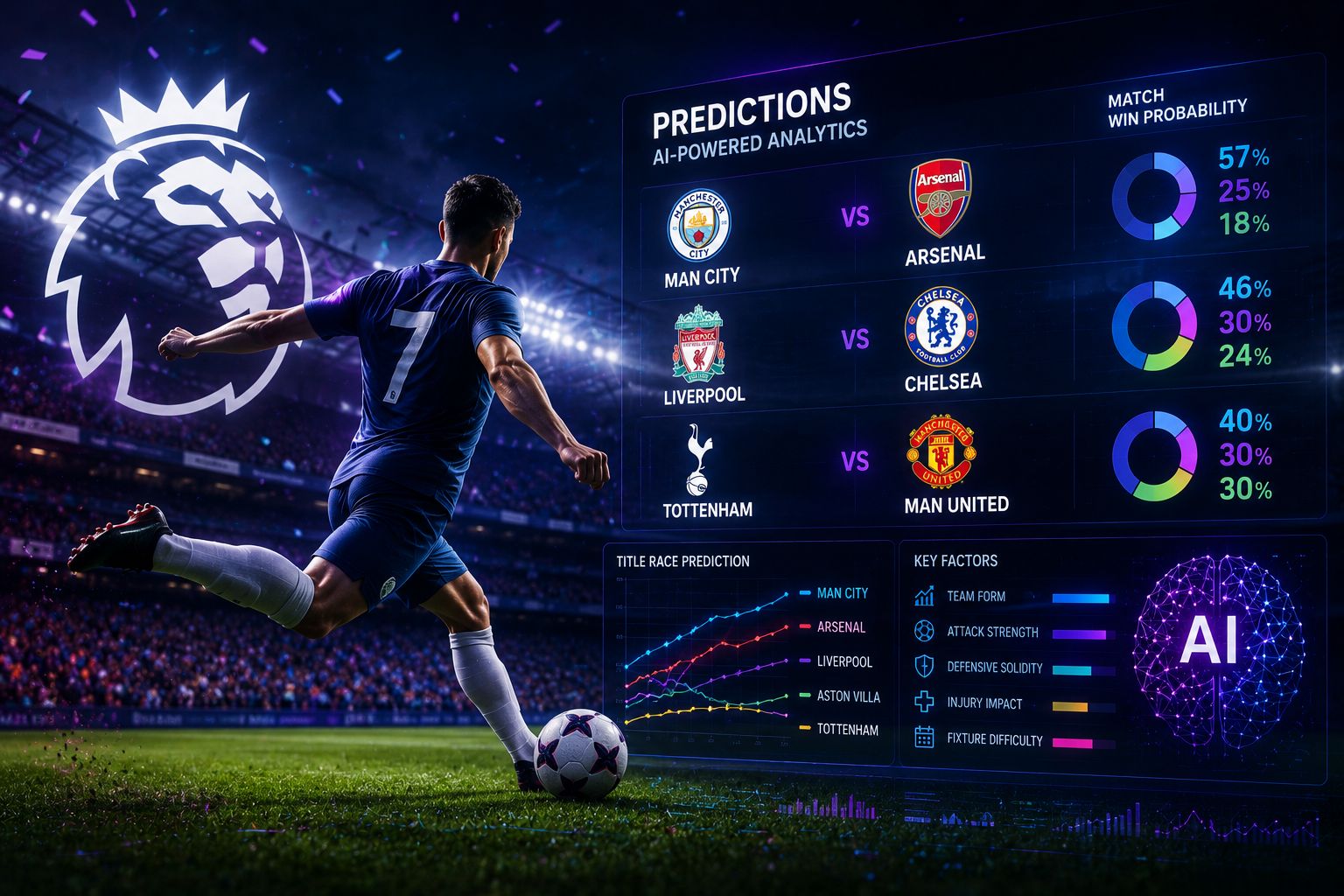
The Premier League is the most analyzed, most-bet, and most-watched football competition in the world. This creates a fundamental challenge for anyone trying to find betting edge: the market is among the most efficient in global sports. Every match attracts enormous sharp money, sophisticated bookmaker models price games carefully, and the volume of analytical attention means obvious edges disappear quickly.
Yet edges exist. They’re smaller and harder to find than in less-trafficked competitions, but the Premier League’s structural features – 380 matches per season, depth of available data, and persistent public bias toward certain teams – create opportunities for genuinely systematic approaches.
This guide explains how AI models analyze Premier League matches, what creates edge in EPL betting, how to evaluate prediction services for football, and what realistic returns look like in one of the world’s most competitive betting markets.
Understanding the market dynamics is essential before discussing prediction methodology.
Volume and liquidity. Premier League matches attract massive betting volume across global markets. This creates deep liquidity (you can place reasonable-sized bets without moving lines) but also rapid price discovery (inefficiencies get priced in quickly).
Sharp money concentration. Professional bettors and syndicates focus heavily on Premier League because of the volume opportunity. This concentrates sharp action that aggressively prices out obvious mispricings.
Public bias persistence. Despite sharp money pressure, certain public biases persist:
Bookmaker investment. Sportsbooks invest heavily in Premier League pricing. This creates highly efficient lines but also means rare inefficiencies represent real opportunities when they occur.
Limit and account treatment. Successful Premier League bettors get limited or banned faster than in less-trafficked markets. This is the cost of competing where the volume is.
The net effect: Premier League offers steady volume opportunity for skilled bettors but requires sophisticated methodology to find edge that survives the competitive pricing environment.
Before discussing how models approach Premier League, understanding why football is structurally harder than other major sports.
Low scoring with high variance. Most Premier League matches produce 0-5 total goals. Single deflections, refereeing decisions, or moments of brilliance change outcomes that wouldn’t matter in higher-scoring sports.
Three-way result market. Home/draw/away markets are fundamentally different from two-way markets. Models must predict probability distribution across three outcomes accurately, not just identify the more likely winner.
Tactical heterogeneity. Two teams can play wildly different systems. The matchup matters more than aggregate quality. Models must capture style interactions.
Set piece variance. Goals from corners and free kicks have high game-to-game variance. Teams that score or concede more set-piece goals than expected in short term cause model errors that resolve only over larger samples.
Goalkeeper dependence. Match outcomes hinge disproportionately on goalkeeper performance. Even strong models lose money during stretches of unusual goalkeeper play.
Single moment decisive. Football outcomes often depend on individual moments – one through-ball, one defensive lapse, one referee decision. This game-to-game variance makes models look bad over small samples even when correct over large ones.
The consequence is that even strong Premier League prediction models experience significant variance. Losing streaks of 8-12 picks happen mathematically over time. This is normal, not evidence of model failure.
Modern Premier League prediction systems use sophisticated combinations of data and modeling.
Expected goals revolutionized football analytics. Models use xG as a core input because it measures underlying performance better than goals themselves.
Why xG matters:
xG aggregation matters. Different xG models produce slightly different numbers. Sophisticated systems average multiple xG sources or build proprietary versions.
Adjustments for context:
The Premier League collects player tracking data (position, speed, distance covered) for every match. This data feeds increasingly sophisticated models.
What tracking reveals:
Why it matters for predictions. Recent results don’t always reflect underlying play patterns. A team’s tracking metrics show how they’re actually performing tactically, independent of goal-scoring variance.
Football is uniquely sensitive to lineup composition. Models track:
Expected lineups: Based on team news, recent rotations, and managerial patterns Tactical setup: Likely formation and approach based on opponent and competition context Key player availability: Star players being available or absent shifts win probability significantly Manager tendencies: Rotation patterns in different competitions (Champions League weeks, FA Cup, etc.)
The challenge: official lineups are typically announced an hour before kickoff. Models must adjust quickly when actual lineups differ from expected.
Premier League teams face varying fixture loads, especially those in European competitions.
Fatigue effects:
Models adjust for:
How specific teams interact based on tactical approaches matters enormously.
Examples of style effects:
Sophisticated models capture these: Through historical data on similar style matchups, models predict how specific teams’ styles will interact in upcoming matches.
Not all EPL betting markets are equally exploitable. Edge concentrates in specific areas.
The basic home/draw/away market. Most efficient for high-profile matches; more inefficient for mid-table matchups.
Where edge concentrates:
Where edge is limited:
Two-way market eliminating draw complication. Generally more efficient than 1X2 but offers consistent value.
Why it’s exploitable:
One of the strongest single markets for systematic Premier League betting.
Why edge exists:
What models analyze:
A binary market on whether both teams score. Generally well-priced but offers occasional value when team patterns shift.
First-half results, totals, and both teams to score. These markets get less analytical attention and can offer edge for models that specialize in early-game patterns.
Growing market for shots, cards, tackles, goals, and other player-specific events. Markets less efficiently priced than game lines but with lower limits.
Even strong AI prediction systems have predictable failure modes in Premier League.
Lineup surprise sensitivity. When teams rotate or rest stars unexpectedly, models trained on expected lineups produce wrong predictions. Champions League midweek games particularly vulnerable.
Cup competition adaptation. Domestic and European cup matches have different patterns than league play. Models heavily trained on league data underperform in cup contexts.
Newly promoted team uncertainty. Models lack adequate data on newly promoted teams. Early-season predictions for these teams often have larger errors than for established Premier League sides.
Manager change effects. When teams change managers, historical patterns become less reliable. Models take time to recalibrate for new tactical approaches.
Set piece variance. Teams that score or concede unusually many set pieces in recent matches create model errors. Some of this is real skill; much is variance that regresses.
Referee assignment effects. Different referees produce different patterns (cards, penalties, advantage played). Models incorporating this data outperform those that don’t.
Weather impact. Heavy rain or wind shifts scoring patterns. Models that don’t incorporate weather miss meaningful predictive variables.
Pure algorithmic systems make systematic errors that human review catches. The strongest Premier League prediction services combine AI candidate generation with human analytical review.
AI handles:
Human review handles:
69advisory operates on this hybrid principle for Premier League coverage. AI-driven candidate generation followed by human analyst review before each pick is published. The marketing is less catchy than “pure AI” claims, but the methodology is what actually produces consistent results in competitive markets like the EPL.
The EPL is among the world’s most efficient betting markets. Yield expectations must reflect this reality.
For pure Premier League betting:
The EPL doesn’t offer the inefficiency available in less-trafficked markets. Strong systematic approaches produce modest but real edge that compounds over time through volume.
For context, 69advisory’s documented 18,19% yield is measured across a multi-sport portfolio combining Premier League with MLB, NHL, KBO, NPB, and major tournaments over thousands of bets and multiple years. The multi-sport diversification matters – pure Premier League-only yields above 8% over major samples are virtually unknown because of the market’s efficiency.
This is why multi-sport portfolios outperform single-sport specialization for systematic bettors. Different sports offer different inefficiency profiles. Combining them stabilizes returns while maintaining overall edge.
For bettors interested in developing systematic EPL approaches, practical considerations.
Free and paid options for Premier League data:
Quality of data matters. Free sources are sufficient for initial analysis but lack the granularity that paid sources provide.
Track every bet with:
Without rigorous tracking, you can’t evaluate methodology effectiveness.
Building genuine Premier League edge requires substantial time:
For most bettors, this time investment exceeds the practical return given the market’s efficiency.
The Premier League is one of the markets where subscribing to professional services often makes more sense than building independent analysis. The market efficiency means edges are small, methodology must be sophisticated, and the time investment to compete is substantial.
Professional services that have built capability over years provide access to that methodology without requiring you to replicate it. The challenge is identifying services with genuine analytical foundation versus marketing claims.
Apply these criteria when evaluating any service.
Methodology transparency. Legitimate services can explain their general approach to EPL analysis – what data they use, how they incorporate xG, how they handle lineup uncertainty, what their typical confidence range is. Services hiding behind “proprietary AI” usually lack genuine methodology.
Track record depth. Demand 1,000+ documented Premier League bets minimum. Multiple seasons. Both win rate and closing line value disclosed. Losing streaks and bad months explicitly shown.
Realistic yield claims. Pure Premier League yields above 10% over significant samples should trigger skepticism. Multi-sport portfolios including EPL with 15%+ aggregate yield are plausible (as 69advisory demonstrates) but require the diversification context to be reasonable.
Risk reversal. Money-back guarantees, free trials, or refund policies indicate confidence in long-term performance.
Hybrid approach. Services explicitly combining AI methodology with human review are typically more reliable than “100% AI” marketing claims.
Consistent claims. Services that describe sophisticated analytical methodology should produce systematic, probability-based recommendations – not narrative-style “I really like Arsenal tonight” analysis.
Subscribing to even the best EPL service requires disciplined execution.
Execute every pick at recommended stakes. The most common failure mode is selective execution – skipping picks that “don’t feel right” and doubling up on plays subscribers like. This converts systematic edge into emotional betting.
Get prices when published. EPL lines move significantly during the betting window, especially after lineup announcements. Picks taken after major sharp action has occurred have inferior expected value.
Track your actual results. Service-published yields are aggregate. Your real results depend on which picks you executed and prices obtained. Most subscribers underperform published track records due to execution issues.
Be patient through variance. Football’s high variance means even strong models have losing weeks. The 38-week Premier League season provides meaningful sample but stretches of poor results are inevitable.
Consider multi-market exposure. Services that diversify across match result, totals, props, and handicaps smooth variance compared to single-market exposure.
Account for limits and account longevity. Successful Premier League bettors get limited or banned at sportsbooks. Spread action across multiple books to extend account longevity.
Premier League prediction is the most competitive betting market in football and one of the most competitive in global sports. The combination of analytical attention, sharp money, and bookmaker investment creates an environment where:
For bettors interested in sustainable football betting, the realistic path involves either substantial personal analytical investment or subscription to professional services with validated methodology. Either approach requires accepting realistic yield expectations and the variance inherent in football’s structural characteristics.
The bettors who succeed in Premier League long-term aren’t those finding “guaranteed locks” or following hot tipsters – they’re those treating EPL betting as systematic work with realistic expectations about edge and variance.
Premier League predictions represent the most analyzed sport in the world. Edge exists but is smaller and harder to capture than in less-trafficked competitions. Modern AI models combined with human review produce the strongest systematic results, achieving modest but sustainable yields when methodology is rigorous and execution disciplined.
The market for “Premier League predictions” contains far more marketing than methodology. Real algorithmic services with legitimate EPL analytical capability exist but are outnumbered by services using “AI” and “expert picks” as marketing buzzwords without substantive analytical foundation.
Apply the evaluation criteria here. Demand methodology transparency. Verify track records over adequate samples. Check yield realism against the mathematical reality of Premier League market efficiency. And remember that even the best service requires disciplined execution from you to deliver theoretical results.
Premier League rewards systematic analytical attention more than it rewards intuition. The bettors who succeed are those who accept the market’s competitive reality and approach it with appropriate methodology, realistic expectations, and disciplined execution over the long sample sizes that football’s variance requires.
18,19% yield. One AI-driven pick per day across Premier League, MLB, NHL, KBO, NPB. Start with 69advisory →

In-Play & Live Betting Tips: Where the Real Edge Hides
In-play and live betting tips explained. Why live markets are less efficient, where the edge hides, the discipline it demands, and how 69 Advisory’s data-driven model reads live value.
Read article
Best Betting Tips & Prediction Apps: What to Look For
Best betting tips and prediction apps in 2026: the features that matter, the red flags to avoid, and why a data-driven service like 69 Advisory delivers value picks straight to your phone.
Read article
Player Props Betting Tips: Finding Value in Softer Markets
Player props betting tips and why prop markets hide value. How data-driven analysis from 69 Advisory finds edges in player performance bets that sharper main markets no longer offer.
Read article

 Back to blog