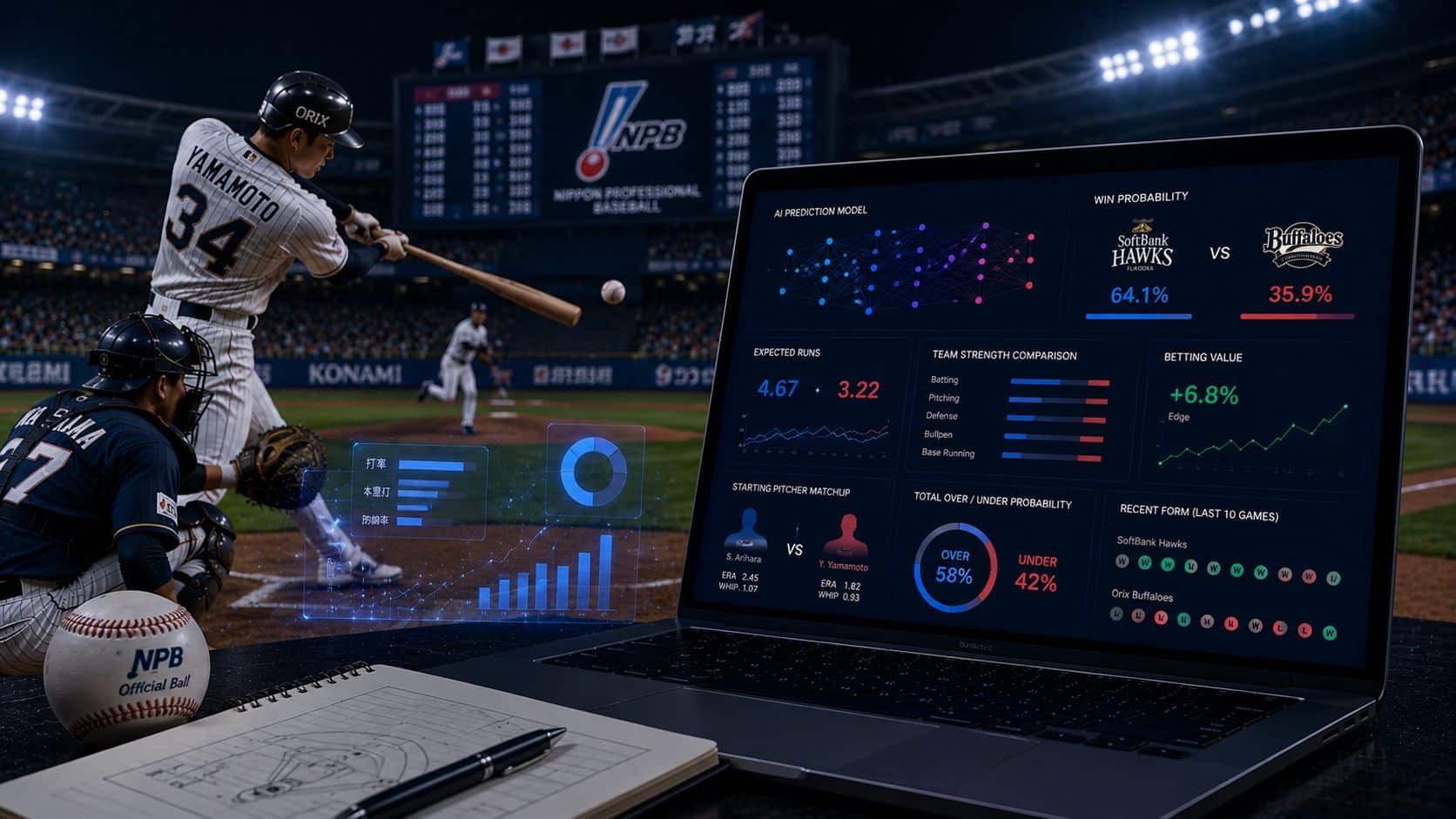
Most Western bettors approach Japanese baseball as an afterthought – betting it occasionally during MLB downtime or chasing perceived value without understanding the league’s unique characteristics. This approach loses money systematically because Japanese baseball isn’t just “baseball played in Japan” – it’s a distinct competitive ecosystem with different tactical priorities, different statistical patterns, and different market dynamics than MLB.
Bettors who treat NPB strategically rather than casually find one of the most exploitable major sports markets in the world. The combination of comprehensive available data, persistent informational asymmetries between Japanese and Western audiences, and limited sharp money pressure creates conditions where analytical work produces sustained edge.
This strategic guide explains what you need to know to bet Japanese baseball intelligently, whether you’re building your own analytical framework or evaluating professional prediction services.
The strategic foundation starts with grasping how the league actually works.
Two leagues, twelve teams. The Central League (Yomiuri Giants, Hanshin Tigers, Hiroshima Toyo Carp, Tokyo Yakult Swallows, Yokohama DeNA BayStars, Chunichi Dragons) and the Pacific League (Fukuoka SoftBank Hawks, Chiba Lotte Marines, Tohoku Rakuten Golden Eagles, Saitama Seibu Lions, Orix Buffaloes, Hokkaido Nippon-Ham Fighters). Each league plays a 143-game regular season.
Limited interleague play. Teams play primarily within their own league, with a designated interleague window (typically May-June) when Pacific and Central League teams face off. This structure creates familiarity effects within leagues and uncertainty during interleague play – both significant for prediction.
Climax Series and Japan Series playoffs. The top three teams in each league advance to the Climax Series, with the league winners receiving a first-round bye. League champions meet in the Japan Series for the championship.
Tie game rules. Regular season games can end in ties after 12 innings. This is different from MLB and affects moneyline pricing calculations.
Roster construction. Teams can have up to four foreign players on the active roster but only three in the same game. The performance and management of foreign players is a critical competitive factor.
These structural elements aren’t curiosities – they’re directly relevant to prediction strategy and market analysis.
The two leagues developed distinct cultures and tactical approaches that persist even after rule unification.
Historically uses the DH (designated hitter), creating offensive environment differences from the Central League. Pacific League teams have traditionally emphasized:
Strategic implications for betting:
Historically didn’t use the DH until 2020. Traditional emphasis on:
Strategic implications for betting:
When Pacific and Central League teams meet, style mismatches create both opportunity and challenge:
The strategic point: NPB isn’t one league, it’s effectively two distinct competitive environments. Treating them uniformly misses critical structural factors.
Foreign players (gaikokujin senshu) represent one of the most important strategic factors in NPB betting that casual bettors consistently underweight.
Roster impact. Each team can have up to four foreign players, with three active per game. For competitive teams, foreign players typically include one or two starting pitchers and one or two position players (often power hitters or first basemen).
Quality variance. Foreign player performance varies dramatically based on adaptation to Japanese baseball. The same player who succeeded in MLB might struggle in NPB; players who never reached MLB sometimes become dominant in Japan. The adaptation curve creates volatility that sophisticated models track carefully.
Strategic implications:
When a team’s foreign starter is scheduled to pitch, win probability shifts significantly. A team starting their dominant foreign ace versus their fifth Japanese starter is a different team for that game.
When foreign players are injured, scratched, or struggling, the team-quality drop is often larger than recreational bettors recognize. Markets sometimes underprice these effects.
Year-over-year foreign player turnover creates roster volatility. Teams that lose strong foreign players in offseason transactions often decline more than aggregate metrics suggest.
Mid-season foreign player signings sometimes dramatically change team quality. Teams that acquire a strong foreign player in mid-summer often improve immediately in ways that delayed sportsbook line adjustment fails to capture.
Practical implications for betting:
Track confirmed starting rotations daily. Foreign starter announcement is more critical for NPB than for MLB equivalents.
Monitor foreign player injury status. Information often takes longer to reach Western bettors than it should.
Pay attention to mid-season signings. New foreign player additions sometimes precede team performance improvements that markets are slow to recognize.
Japanese ballparks vary significantly in their effects on scoring. Strategic NPB bettors track park factors carefully.
Domed stadiums. Tokyo Dome (Yomiuri Giants), Fukuoka PayPay Dome (SoftBank Hawks), Kyocera Dome Osaka (Orix Buffaloes), Sapporo Dome (Nippon-Ham Fighters, until 2022 move to Es Con Field), Vantelin Dome Nagoya (Chunichi Dragons), MetLife Dome (Seibu Lions, semi-domed). Climate-controlled environments produce consistent conditions but different scoring environments from each other.
Outdoor stadiums. Hanshin Koshien Stadium (Tigers), Mazda Stadium (Hiroshima Carp), ZOZO Marine Stadium (Chiba Lotte Marines), Meiji Jingu Stadium (Yakult Swallows), Yokohama Stadium (DeNA BayStars), Rakuten Mobile Park Miyagi (Rakuten Eagles), Es Con Field Hokkaido (Nippon-Ham Fighters). These have weather-dependent scoring environments.
Notable parks for betting:
Strategic bettors adjust expected scoring based on park factors specific to each game’s venue.
Japan’s distinct climate patterns create predictable scoring environment shifts.
Spring (March-April). Cooler temperatures depress offense. Early-season games often produce lower scoring than mid-summer.
Rainy season (June). Humidity affects pitching command. Rain delays and short-rest situations affect pitcher performance.
Summer (July-August). Hot, humid conditions inflate offense. Highest-scoring period of the season.
Autumn (September-October). Cooler temperatures, often windier conditions. Scoring patterns shift back toward pitching-friendly.
Strategic implications. Game totals should adjust seasonally. Bettors and bookmakers who maintain static totals across the season miss these systematic shifts. Models that incorporate seasonal weather patterns find consistent edge on totals.
A core strategic principle for Japanese baseball – shared with MLB but particularly relevant in NPB markets – is distinguishing recent results from underlying performance.
The variance trap. Short sequences of results don’t reflect actual team quality. A 5-1 stretch can happen to mediocre teams; a 1-5 stretch can happen to good teams. Markets that overreact to recent results create edge for bettors who look beyond surface-level form.
What matters more than win-loss record:
Practical strategy. When markets price teams heavily on recent results that diverge from underlying performance, opportunities emerge. Strong teams in slumps offer value; weak teams on hot streaks become fading opportunities.
NPB’s schedule creates distinct patterns from MLB.
Game days and rest days. NPB plays a similar daily schedule to MLB but with more frequent travel-related off-days and slightly different rest patterns. Teams typically don’t play more than 6 consecutive days without an off-day.
Travel patterns. Japan’s geography creates specific travel patterns. Some matchups involve significant flights (Sapporo to Fukuoka, for example); others are short rail trips. Travel effects on performance are real but less extreme than MLB cross-country travel.
Doubleheaders. Less common than historically but still occur, particularly to make up rain-postponed games. Doubleheader performance follows predictable patterns – second-game offensive performance often differs from first-game.
Strategic implications. Track team schedules carefully. Teams in heavy stretches without rest, or teams playing after long travel, perform differently than aggregate metrics suggest.
Not all NPB betting markets are equally exploitable.
Game totals. The strongest single market for strategic bettors. Markets often slow to adjust to scoring environment shifts (weather, ballpark, recent offensive trends). Bettors who properly model run scoring find consistent edge.
Run lines. Higher pricing inefficiency than moneylines. The 1.5 run handicap creates more pricing errors when sportsbook models are less sophisticated for NPB than MLB.
First five innings markets. Focus on starting pitchers while excluding bullpen variance. Edge available for bettors with strong pitcher analytical inputs.
Team totals. Individual team scoring markets get less risk-management attention than game totals.
Markets to approach cautiously:
Japan Series and Climax Series games. Postseason concentrates sharper money. Edge shrinks during playoffs.
Heavy favorites. Even with edge, -300 or worse moneyline favorites rarely deliver value after vig.
Live betting. Limited live-betting infrastructure for NPB internationally means inferior prices and limits.
Bettors approaching NPB without proper preparation make predictable errors.
Applying MLB intuition without adjustment. Japanese baseball culture, tactical approaches, and structural rules create patterns that don’t match MLB. Bettors using MLB heuristics on NPB consistently lose.
Ignoring league differences. Treating Pacific League and Central League as interchangeable misses important structural factors.
Underweighting foreign player effects. When a team’s foreign starter is injured or struggling, the impact is large and markets are slow to adjust.
Following translated news without context. English summaries often oversimplify or lag actual developments. Bettors acting on these are often acting on stale information.
Big-market team bias. Yomiuri Giants (Tokyo) and Hanshin Tigers (Osaka) attract reflexive betting attention. Their lines often reflect public bias rather than current quality.
Insufficient sample sizes. A bettor’s first 100 NPB bets can profit or lose primarily through variance. Drawing conclusions from small samples is the most common analytical error.
Time zone fatigue. NPB games run overnight for Western bettors. Sustainable betting requires either matching your schedule or relying on advance picks from a service.
Strategic NPB betting requires either building your own analytical framework or subscribing to a service with genuine Japanese baseball expertise.
Building your own. This requires:
For most bettors, this isn’t realistic. The time investment doesn’t match the bankroll potential for non-professional bettors.
Using a professional service. This requires identifying services with:
69advisory built NPB coverage during the 2020 COVID-era expansion and has maintained dedicated Japanese baseball analytical work since. The 18,19% documented yield is measured across a multi-sport portfolio (MLB, NHL, Premier League, KBO, NPB, major tournaments) over thousands of bets and multiple years – the multi-sport diversification matters because pure single-league exposure has higher variance.
Japanese baseball represents one of the world’s most underexploited major betting markets. The combination of structural and informational factors that create this opportunity:
…won’t disappear quickly. Global sports betting infrastructure continues to develop, but the timeline for NPB markets to reach MLB-level efficiency is measured in years, not months.
For bettors interested in sustainable analytical edge during this period, NPB offers what increasingly disappears in major North American markets: room for genuine analytical work to produce meaningful returns over time.
Japanese Professional Baseball rewards strategic analytical attention more than most major betting markets. The structural complexity (two leagues, foreign player rules, distinct ballpark factors) combined with persistent informational asymmetries creates conditions where systematic analytical approaches consistently outperform casual betting.
Whether you build your own analytical framework or subscribe to a professional service, the strategic principles remain consistent: understand the league’s unique structure, account for foreign player effects, adjust for park and weather factors, distinguish recent results from underlying performance, and maintain disciplined execution over adequate sample sizes.
NPB is one of those markets where serious work pays off. When you approach Japanese baseball strategically rather than casually, you’re competing in a market that hasn’t yet priced out the kinds of edges that disappeared from MLB years ago.
18,19% yield. One AI-driven pick per day. NPB included. Start with 69advisory →
Chasing Losses: The Psychology of Tilt and How to Interrupt It
Chasing costs more money than bad selections ever will. Here is what is actually happening cognitively, and the interventions that work.
Read articleSetting Betting Limits That Actually Hold: A Practical Guide
Good intentions fail under pressure. Deposit limits, time-outs and self-exclusion work because they do not rely on willpower at the moment it is weakest.
Read articleThe Late-Inning Rules Most Bettors Miss: Three-Batter Minimum and Blowout Pitching
Two rule changes quietly reshaped how late innings are pitched. Both are public, both are precise, and both affect live totals more than most bettors realise.
Read article

 Back to blog