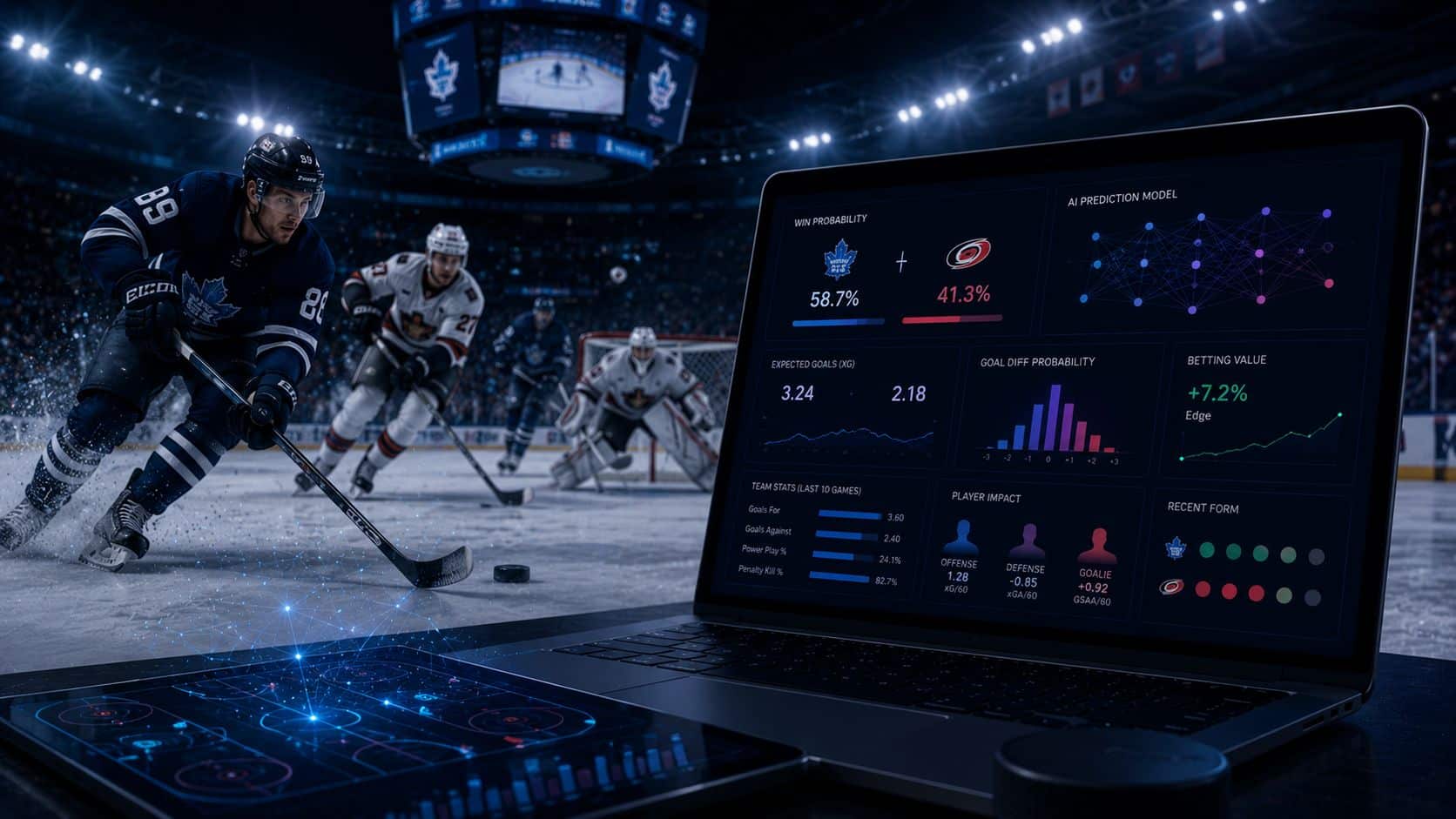
Hockey is the most data-rich major sport that recreational bettors least understand. The same analytics revolution that transformed baseball front offices has hit hockey, but consumer perception lags significantly behind. The result is one of the most exploitable major sports markets for algorithmic prediction systems.
NHL computer picks – genuine algorithmic predictions, not just spreadsheet handicapping – have become increasingly central to professional hockey betting. The combination of high-quality publicly available analytics (Corsi, Fenwick, expected goals, high-danger chances), puck and player tracking data, and a market that still prices games heavily on traditional statistics creates persistent edge for systematic approaches.
This guide explains how NHL computer picks actually work, what hockey analytics drive them, and how to identify legitimate algorithmic services in a market saturated with marketing-heavy alternatives.
To understand why algorithmic NHL prediction works, you need to understand what most bettors get wrong.
The market loves “results” over process. Hockey is high-variance at the individual game level. Bad teams beat good teams routinely. Goaltender hot streaks distort short-term results. Bettors and casual handicappers focus on recent wins and losses; the market prices games partially on this perception. Models that look beyond results to underlying performance find consistent edge.
Goaltender variance is wildly misunderstood. A backup goalie having a hot two-week stretch can make a mediocre team look elite to bettors who watch the box scores. Models that recognize this as variance rather than skill consistently profit from regression.
Hockey rewards depth, not stars. Unlike basketball, where a single star transforms a team, hockey is more about depth, system fit, and coaching. Markets that overprice teams with marketable stars create edge for models that focus on aggregate quality.
Public bias toward overs and Original Six teams. Public money systematically backs popular teams (Maple Leafs, Rangers, Blackhawks) and bets overs. Even when these teams are good, the lines on them are often inflated. Models that systematically fade public bias capture this edge.
Recreational bettors don’t understand advanced stats. Casual hockey fans still think wins and losses tell the story. Models that have moved beyond this – to expected goals, shot quality, and possession metrics – have informational advantages that take years to dissipate.
The result is a market that prices games inefficiently in ways that algorithmic systems systematically exploit.
Hockey analytics have evolved rapidly. Understanding what data drives modern NHL prediction models requires grasping the basic framework.
Corsi – Total shot attempts (shots, missed shots, blocked shots) for vs against. The original possession metric, it measures which team controls play regardless of shooting talent. Corsi For Percentage (CF%) shows what proportion of shot attempts a team or player generates.
Fenwick – Corsi minus blocked shots. Some analysts prefer this because blocked shots can be situational and don’t always reflect possession quality.
These metrics matter because shot volume predicts goal scoring better than goals themselves over reasonable samples. A team generating 60% of shot attempts but losing because of unsustainably bad shooting percentages is about to regress positively – and models capture this before the market does.
Volume isn’t everything. A team firing 60 shots from the perimeter is worse off than one taking 30 from prime scoring areas.
Expected Goals (xG) – The probability that each shot will result in a goal based on location, shot type, and game state. Aggregated, xG provides a more accurate measure of team performance than actual goals scored, especially over short samples.
High-Danger Chances – Shots from the most dangerous areas (slot, low slot, rebounds, breakaways). Teams that consistently generate or prevent these chances outperform their box score numbers over time.
Scoring Chances – A broader category capturing all reasonable scoring opportunities. The ratio of scoring chances to actual goals is a critical predictor of future performance.
Hockey performance varies dramatically by game state – leading, trailing, tied, on the power play, killing a penalty, in overtime. Aggregate statistics that don’t account for game state are misleading.
Score-Adjusted Statistics – Performance metrics weighted to neutralize the effect of game state. Teams playing from behind throw more shots in lower-quality situations; metrics that don’t adjust for this overstate trailing teams’ actual quality.
Score-and-Venue Adjusted – Further refinement accounting for home vs away effects in different game states.
NHL games hinge significantly on special teams play. Models track:
A team’s PP/PK splits often diverge from their overall quality, creating matchup-specific edges that models capture.
Goaltender quality is the biggest single variance source in hockey outcomes.
Save Percentage (Sv%) – Basic but volatile. A goaltender with a .920 Sv% over 10 games might have a true talent .910 Sv%.
Goals Saved Above Expected (GSAx) – Based on shot quality data, this measures how many goals a goaltender has saved beyond what an average goaltender would have stopped given the same shot profile. Far more predictive of future performance than Sv%.
High-Danger Sv% – Save percentage on high-danger shots specifically. The most predictive measure of true goaltending talent.
Models that distinguish goaltender quality from variance dramatically outperform handicappers who look at recent results.
A genuine algorithmic NHL prediction system combines these data inputs into probability estimates for each game.
Base team ratings. Aggregate team quality measured through possession and shot quality metrics, adjusted for game state. This provides the foundation – which team is actually better, controlling for the noise of recent results.
Goaltender adjustments. Expected starter quality (using GSAx and high-danger Sv%) significantly modifies base ratings. The same team with a backup versus a starter generates different probability distributions.
Lineup and injury adjustments. Top-line players matter disproportionately in hockey. Models adjust for confirmed scratches, injury reports, and lineup changes.
Schedule context. Back-to-back games, travel patterns, recent rest. Teams playing the second game of a back-to-back with travel underperform aggregate ratings; models capture this.
Matchup specifics. Stylistic interactions matter – a possession-heavy team facing a tight defensive system generates different outcomes than facing a fast-paced opponent. Advanced models capture these style effects.
Live market comparison. The final prediction probability is compared against current sportsbook lines. Bets are recommended only where the model’s probability significantly exceeds implied probability from the offered odds, accounting for vig.
Stake sizing. Edge percentage and confidence level determine recommended stake size, typically through Kelly criterion variations or similar bankroll management math.
Pure algorithmic systems make systematic errors that human review catches. The most effective NHL prediction services combine AI candidate generation with human analyst review.
The AI handles:
Human review handles:
69advisory operates on this hybrid principle – AI-driven candidate generation followed by human analyst review before each pick is published. The marketing is less catchy than “100% AI” claims, but it’s what actually produces consistent long-term results.
Setting realistic expectations is essential.
The vig reality. Most NHL games are priced at -110 or close on puck lines and totals. Moneylines vary more widely. To break even at -110, you need to win 52.4% of bets.
Long-term professional yields in NHL:
For context: 69advisory’s documented 18,19% yield is measured across a multi-sport portfolio (MLB, NHL, Premier League, KBO, NPB, major tournaments) over $95,000+ in tracked bets and multiple years. The multi-sport approach matters – pure NHL-only yields above 12% over major samples are virtually unknown.
A claim of “20%+ NHL-only yield” over several full seasons should trigger skepticism, not excitement. The math doesn’t support these claims at scale.
Not all NHL betting markets are equally exploitable. Edge concentrates in specific areas.
Puck lines – The 1.5 goal handicap creates more pricing inefficiency than moneylines, especially when bookmakers respond to public action.
Totals – The over/under market is often slow to adjust to underlying shot generation and goaltending quality. Strong models find consistent edge here.
First period markets – First period results are weighted more heavily by goaltender play, and many bettors don’t analyze these markets carefully. Edge can be larger but variance higher.
Period and game props – Lower volume markets get less attention from sportsbook risk management, creating opportunities for models.
Less profitable markets:
Heavily-bet matchups. Saturday night games and high-profile matchups attract sharp money that prices markets efficiently.
Original Six and other public teams. Lines on Maple Leafs, Rangers, Blackhawks, and Penguins often reflect public bias. Sometimes this creates edge (fading), sometimes it just makes pricing inefficient in both directions.
Heavy favorites. Money line favorites at high prices (-200 or worse) rarely offer enough edge to justify the risk, even for accurate models.
Apply these criteria to any service you’re evaluating.
A legitimate service can explain its general approach: what data it uses, what its model considers, how it combines algorithmic and human inputs. Services hiding behind “proprietary technology” with zero further detail typically have nothing to hide because there’s nothing there.
Demand to see:
Short track records can’t distinguish edge from luck. Hide-the-bad-results services systematically deceive.
Anyone claiming 25%+ NHL-only yield over major samples should immediately raise red flags. Sustainable professional yields top out below 12% even for excellent models.
Money-back guarantees, free trials, or refund policies indicate confidence in long-term performance. Non-refundable annual payments without trial periods protect the service from accountability.
Services claiming “algorithmic AI predictions” while publishing narrative-style “I really like the Rangers tonight” analysis are mismatched. Real algorithmic services produce systematic probability-based recommendations.
Even legitimate NHL prediction systems fail in predictable patterns.
Goalie change surprises. Models trained on expected starters can be sharply wrong when teams make last-minute changes. Services without strong morning-skate monitoring underperform during high-rotation periods.
Hot/cold streaks attribution. Distinguishing actual performance changes from variance is difficult. Models that adjust too aggressively to recent results create errors; models that don’t adjust enough miss real changes.
Playoff context shifts. Playoff hockey is structurally different from regular season – tighter checking, more defensive play, single-goal games more common. Models heavily trained on regular season data can underperform in playoffs.
International tournament adaptation. Models built on NHL data don’t always translate well to international tournament play (Olympics, World Championships) where systems and roster construction differ.
Travel and rest effects in shortened seasons. Compressed schedules amplify rest effects. Models calibrated to normal schedules can underperform during heavy travel stretches.
Subscribing to even the best service requires disciplined execution from you.
Execute every pick at recommended stakes. Selective execution destroys systematic edge.
Get prices when published. NHL lines move during the day; late execution erodes edge.
Bet at sharp books or exchanges when possible. Lower vig preserves more theoretical edge.
Track your own results. Most subscribers underperform published yields due to execution issues.
Be patient through variance. 10-game losing streaks happen mathematically. Quitting during downswings locks in losses.
Diversify across markets. Mixing moneylines, puck lines, totals, and props smooths variance without sacrificing aggregate edge.
The NHL regular season produces 82 games per team, 1,312 league games total before playoffs. This volume enables:
Statistical significance within seasons. Real edge can be demonstrated over a single season at adequate volume.
Smooth bankroll progression. Daily action smooths bad nights into long-term trends.
Multi-market specialization. Different markets (moneylines, puck lines, totals) have different edge profiles; volume supports specialization.
Practical scale. Modest yields produce meaningful absolute profit at hockey-betting volume.
This is why NHL attracts attention from professional sports investors. The combination of analytical depth, public market inefficiency, and high game volume creates conditions where systematic edge compounds into significant long-term returns.
Algorithmic prediction has transformed NHL betting more than most bettors realize. The combination of advanced hockey analytics, sophisticated modeling, and persistent public bias in the market creates conditions where systematic approaches consistently outperform traditional handicapping.
The market around “NHL computer picks” contains far more marketing than methodology. Real algorithmic services with legitimate edge exist – they’re outnumbered by services using “AI” and “algorithms” as marketing buzzwords without genuine analytical foundation.
Apply the evaluation criteria here. Demand methodology transparency. Verify track records with both win rate and CLV. Check yield realism. And remember that even the best service requires disciplined execution from you to deliver theoretical results.
Hockey markets remain inefficient in ways that genuine algorithmic systems exploit consistently. When you find a service combining real methodology with honest transparency, the long-term edge is sustainable – though more modest than marketing typically suggests.
18,19% yield. One AI-driven pick per day. Start with 69advisory →

In-Play & Live Betting Tips: Where the Real Edge Hides
In-play and live betting tips explained. Why live markets are less efficient, where the edge hides, the discipline it demands, and how 69 Advisory’s data-driven model reads live value.
Read article
Best Betting Tips & Prediction Apps: What to Look For
Best betting tips and prediction apps in 2026: the features that matter, the red flags to avoid, and why a data-driven service like 69 Advisory delivers value picks straight to your phone.
Read article
Player Props Betting Tips: Finding Value in Softer Markets
Player props betting tips and why prop markets hide value. How data-driven analysis from 69 Advisory finds edges in player performance bets that sharper main markets no longer offer.
Read article

 Back to blog