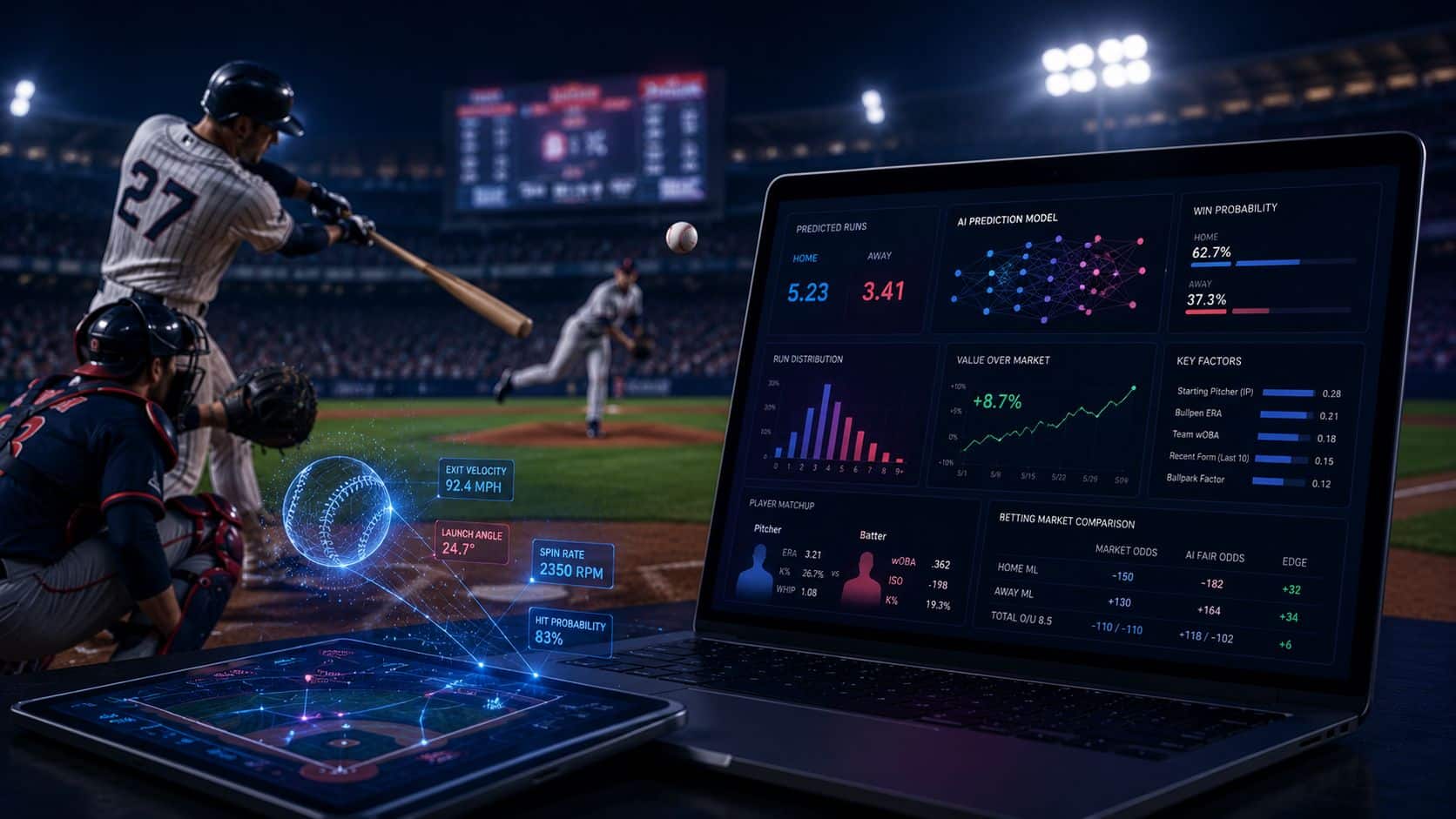
Baseball was made for algorithms. No major sport produces more usable data, generates more independent events per game, or rewards systematic analysis more than MLB. The same statistical revolution that transformed front-office decision-making over the past two decades has quietly transformed sports betting – and Major League Baseball is where the gap between algorithmic and traditional handicapping is widest.
This is why “MLB computer picks” has become such a meaningful search term, and why the category has grown rapidly as bettors have discovered what professional sports investors have known for years: human handicapping in baseball simply can’t compete with well-built algorithmic systems.
This guide explains how MLB computer picks actually work, what data the best models use, and how to evaluate any algorithmic pick service before trusting it with your bankroll.
Baseball’s structure creates the ideal conditions for statistical prediction in ways that other sports don’t match.
Independent events. Each at-bat is essentially independent. A pitcher faces a hitter, the result is one of a discrete set of outcomes, and the next at-bat starts fresh. This independence makes baseball cleaner for statistical modeling than sports where momentum, fatigue, and continuous action create dependencies.
Massive sample sizes. A typical MLB season produces over 2,400 games containing 700,000+ plate appearances. Models train on millions of historical data points covering every imaginable situational context. No other major North American sport approaches this data volume.
Granular metric availability. Statcast captures exit velocity, launch angle, spin rate, pitch location, and dozens of other measurements on every pitch. This isn’t aggregate statistical analysis – it’s detailed physics-level data on every action. Models incorporating this data have inputs that human handicappers literally cannot process.
Stable scoring environment. Despite year-to-year variation, MLB scoring patterns are stable enough that historical models retain predictive value. Football’s rule changes and tactical shifts make older data less reliable; baseball’s underlying structure has been consistent for decades.
Clear isolated matchups. Pitcher versus batter matchups can be modeled in isolation. Football and basketball have systemic effects (offensive schemes, defensive coverages) that complicate analysis. Baseball’s one-on-one matchups are computationally cleaner.
Predictable variance. Run scoring follows known statistical distributions. Win expectancy in different game states is well-understood. Variance can be quantified, which means models can produce calibrated probability estimates rather than rough guesses.
The result: MLB is the sport where algorithmic edge over human handicapping is largest and most sustainable.
The phrase “computer picks” can mean anything from sophisticated machine learning models to a spreadsheet running basic statistical correlations. Here’s what genuine algorithmic MLB prediction systems actually use.
Starting pitchers account for the majority of MLB game outcome variance, so they get the most attention from models.
Recent advanced metrics: SIERA, xFIP, xERA, K/9, BB/9, GB%, barrel rate allowed – these go beyond ERA to measure underlying performance. A pitcher with a 5.50 ERA but elite peripherals is being unlucky and likely to revert; the opposite is true for pitchers with lucky ERAs.
Pitch-level data: spin rates, velocity trends, pitch mix changes, command metrics. Decline trends in stuff often precede performance drops by weeks before they show in results. Models that incorporate this data identify deteriorating pitchers before the market does.
Matchup-specific analysis: how the starter performs against this opponent’s lineup composition (left-handed vs right-handed, contact vs power, etc.), in this ballpark, with this catcher pairing.
Workload and rest: pitch counts in recent starts, days of rest, total innings on the season relative to career patterns.
Bullpens have become decisive in modern MLB. Models track:
Run scoring is modeled at the lineup level, not team aggregate level.
Baseball is uniquely affected by environmental conditions in ways that meaningfully shift run scoring.
Models that ignore weather underperform during weather-affected games. The 5-7% of games with significant weather impacts often produce the biggest model edges.
Home plate umpires have measurable strike zone tendencies that affect run scoring. Plate umpire identity, known before lineup announcement, is incorporated into sophisticated models. Some umpires call larger zones (favoring pitching) or have specific tendencies on borderline pitches that systematically affect game outcomes.
Cross-country travel and time zone changes measurably affect performance. Teams playing the second game of a back-to-back with significant time zone shifts perform worse than aggregate ratings suggest. Models capture these effects; human handicappers often miss them.
The fundamental question: if these models are so effective, why do sportsbooks stay in business?
The answer involves three realities.
Most bettors aren’t using these models. Sportsbooks make their money from recreational bettors who bet favorites, parlays, and trendy teams. Computer picks compete in a small subset of the action where sharp money concentrates. Books accept losing this volume because they win heavily on the recreational majority.
Books adapt to sharp action. When sharp money or syndicate money bets a side, lines move. Sophisticated bettors must beat closing lines, not just opening lines. This is why CLV (closing line value) is the gold standard for measuring algorithmic edge.
Edge is thin even at its best. Profitable MLB models typically produce 3-7% yield. This means $100 bet over 1,000 games returns $103-107 average. Real, sustainable, life-changing if scaled, but not the “85% win rate” claims of marketing materials.
Volume requirements. Algorithmic edge only manifests over hundreds or thousands of bets. Anyone evaluating computer picks over 20-50 games is measuring variance, not edge. Real algorithmic services need sample sizes most subscribers don’t have patience to evaluate.
The sportsbooks that struggle most with computer picks are those with stale lines or slow to adjust. The biggest books (Pinnacle, Circa, Betfair Exchange) move faster but offer lower vig, meaning models can profit there but at thinner margins.
Pure algorithmic systems make systematic errors that humans easily catch. The most successful prediction services combine algorithmic candidate generation with human review.
The AI handles:
Human review handles:
This hybrid approach is the production standard among serious prediction services. 69advisory uses this principle – AI-driven candidate generation followed by human analyst review before each pick is published. The marketing isn’t as catchy as “100% AI” claims, but it’s what actually delivers documented long-term results.
Setting realistic expectations is essential for using MLB computer picks profitably.
The vig reality. Most MLB games are priced at -110 or close. To break even on a -110 line, you need to win 52.4% of bets. This is the bar that all “profitable” picks must clear.
Long-term professional yields in MLB:
For context on real-world performance: 69advisory’s documented track record shows 18,19% yield, but this is measured across a multi-sport portfolio (MLB, NHL, Premier League, KBO, NPB, major tournaments) over $95,000+ in tracked bets and multiple years. Multi-sport diversification stabilizes yield in ways pure single-sport tracking can’t.
For pure MLB-only over multiple full seasons, sustainable yields above 10% are rare. Anyone claiming 25%+ MLB-only yields over major samples should trigger skepticism, not excitement – the math simply doesn’t support these claims over real volume.
What this means in practice. A $50 average stake at 7% yield over a 162-game MLB season generates $567 profit. At 10% yield, it’s $810. Not get-rich-quick territory, but genuine sustainable income at scale. Professional sports investors achieve this through volume across multiple sports and disciplined bankroll management.
The MLB pick industry contains far more marketing than methodology. Here’s how to spot problems.
Implausible yield claims. “85% win rate over the last season” or “guaranteed locks” are marketing fictions. Real models top out below the implied 75-80% win rate range over significant samples. Anyone advertising above that is selling fantasy.
No closing line value disclosure. Win rate alone is misleading; CLV is variance-resistant. Services that show only win percentages and hide CLV are typically benefitting from short-term luck rather than genuine edge.
Hidden losing streaks. Real models lose 8-10 games in a row mathematically over a long season. Services that show only winning months or aggregate season results are hiding the variance that subscribers actually experience.
Premium “lock” pricing. Charging $200 for a single “guaranteed” pick is the classic sports betting scam structure. Real edge in MLB is small per pick and only profitable over volume; charging per pick at premium rates is incompatible with how legitimate models actually work.
Pure AI marketing. “100% algorithmic predictions” sounds impressive but is actually a warning sign for the reasons discussed above. The best services explicitly describe their hybrid AI-plus-human methodology.
No methodology disclosure. A legitimate service can describe its general approach: what data it uses, how it handles bullpen quality, how it incorporates weather and umpire effects. Services hiding behind “proprietary algorithms” with no further detail usually have nothing to hide because there’s nothing there.
Demanding non-refundable annual payments. Established services offer trials, money-back guarantees, or flexible terms. They have confidence in long-term performance. Services demanding non-refundable annual commitments are protecting themselves from accountability.
Even subscribing to a profitable service doesn’t guarantee profitable results.
Execute every pick at recommended stakes. The most common failure mode is selective execution – skipping picks that “don’t feel right” and doubling up on picks subscribers like. This converts a systematic profitable approach into an emotional unprofitable one.
Get the prices when posted. MLB lines move during the day, especially after lineup confirmations. Picks taken late often have inferior prices to those listed. If you can’t execute promptly, your real-world yield will trail published results.
Bet at lower-vig books. Pinnacle (where available), exchanges like Betfair, and reduced-juice books like Circa preserve more of your theoretical edge than recreational books at -110. The same pick at -105 vs -115 makes a huge difference over thousands of bets.
Maintain your own records. Trust but verify. Track which picks you executed, what prices you got, and your actual results. Most subscribers underperform published yields because of execution issues; tracking lets you see exactly why.
Be patient through variance. A 60% win rate model still loses 40% of its bets. Losing streaks of 6-10 games happen routinely over a season. Quitting during a downswing converts temporary variance into permanent capital loss.
Diversify across MLB markets if possible. Moneyline, run line, totals, and props each have different edge profiles. Spreading across markets smooths variance without sacrificing aggregate edge.
MLB’s regular season offers something other sports don’t: enormous volume. Other sports concentrate action into 16-game (NFL) or 82-game (NBA, NHL) seasons. MLB’s 162 games per team mean roughly 2,430 league games per regular season, plus playoffs.
This volume enables:
Statistical significance. Real edge can be demonstrated within a single season at sufficient volume. Other sports often require multi-year tracking to distinguish edge from variance.
Smooth bankroll growth. Daily betting volume means downswings recover quickly. A bad week is followed by 10 more days of action; in football, a bad week dominates an entire weekend.
Specialization rewards. Models can specialize – first 5 innings, run line favorites on the road, totals in specific weather conditions – and accumulate meaningful samples within a season.
Volume-based profit at modest yields. 5-7% yield on high volume produces meaningful absolute profit. The same yield in low-volume sports requires multiple years to generate significant returns.
This is why MLB attracts disproportionate attention from professional sports investors and algorithmic services. The combination of clean data, large sample sizes, and high volume creates conditions where systematic edge actually compounds into meaningful returns.
Algorithmic prediction has fundamentally changed MLB betting. The combination of Statcast data, sophisticated modeling, and computational power has given systematic bettors edges that human handicappers can’t match through intuition alone.
But the industry around “MLB computer picks” contains far more marketing than substance. Real services with legitimate methodology and transparent track records exist – they’re outnumbered by services using “AI” and “algorithms” as buzzwords without genuine analytical foundation.
Apply the evaluation criteria in this article. Demand methodology transparency. Verify track records with both win rate and CLV. Check yield realism against the mathematics of what’s actually possible. And remember that even the best computer pick service requires disciplined execution from you to deliver its theoretical results.
Baseball is the sport where algorithmic edge over traditional handicapping is largest and most sustainable. When you find a service combining real methodology with honest transparency, the long-term edge available is genuine – though more modest than marketing typically suggests.
18,19% yield. One AI-driven pick per day. Start with 69advisory →

In-Play & Live Betting Tips: Where the Real Edge Hides
In-play and live betting tips explained. Why live markets are less efficient, where the edge hides, the discipline it demands, and how 69 Advisory’s data-driven model reads live value.
Read article
Best Betting Tips & Prediction Apps: What to Look For
Best betting tips and prediction apps in 2026: the features that matter, the red flags to avoid, and why a data-driven service like 69 Advisory delivers value picks straight to your phone.
Read article
Player Props Betting Tips: Finding Value in Softer Markets
Player props betting tips and why prop markets hide value. How data-driven analysis from 69 Advisory finds edges in player performance bets that sharper main markets no longer offer.
Read article

 Back to blog